

What Is the Best Water Treatment System for Commercial Buildings with High Demand?
By AXEON Water Technologies | Technical Articles

Technical Articles
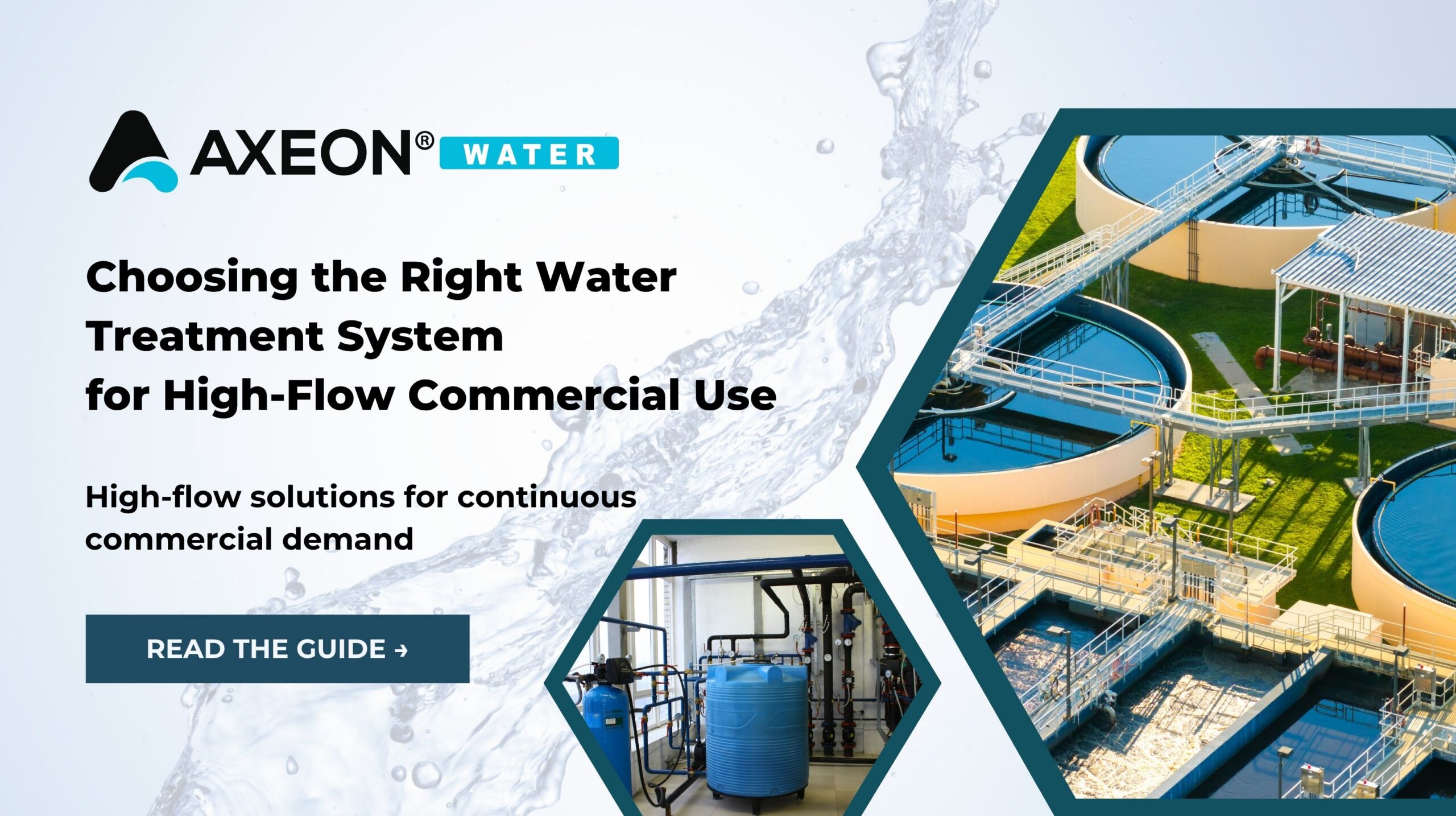
Reverse osmosis (RO) systems are the best all-around water treatment solution for high-demand commercial buildings, delivering 95–99% TDS rejection at flow rates from 12,000 to 570,000+ GPD. High demand refers to facilities processing 10,000+ GPD of treated water daily. The 5 best commercial water treatment systems for high-demand buildings are reverse osmosis, water softening, UV sterilization, carbon and media filtration, and multi-stage combination systems — each addressing a specific water quality requirement.
What Defines "High Demand" for a Commercial Water Treatment System?
"High demand" in commercial water treatment refers to facilities processing 10,000+ GPD of treated water daily under continuous operation. High-demand buildings require consistent pressure output, peak-load flow capacity, and sustained treatment performance. 4 commercial building types exceed this threshold:
- Hotels (300+ rooms) consume 50,000–80,000+ GPD across kitchen, laundry, and guest water supply
- Hospitals and healthcare campuses process 20,000–100,000+ GPD for patient care and facility operations
- Food and beverage manufacturing plants require 15,000–500,000+ GPD for production process water
- Office buildings (500+ occupants) use 10,000–30,000+ GPD across potable and utility systems
What Are the Best Water Treatment Systems for Commercial Buildings?
There are 5 primary water treatment systems for high-demand commercial buildings. Each system addresses a specific water quality challenge — selection depends on building type, daily water demand, and source water quality.
- Reverse Osmosis (RO) Systems reduce dissolved solids, TDS, and inorganic contaminants by 95–99% under tested operating conditions. Commercial and industrial RO systems handle flow rates from 30,000 to 570,000+ GPD at 99% nominal salt rejection. Food and beverage processing, laboratories, breweries, and healthcare facilities use RO systems for high-purity process water production.
- Water Softening Systems (ion exchange) remove hardness-causing calcium and magnesium ions via cation exchange resin, reducing water hardness from 100+ grains per gallon (GPG) to near-zero GPG. Scale accumulation of 1/8 inch on boiler heat transfer surfaces reduces boiler efficiency by up to 25%. Hotels, commercial laundry facilities, and HVAC cooling towers use water softening systems to protect equipment from scale damage.
- UV Sterilization Systems expose water to ultraviolet light at validated dosage levels, disrupting microorganism DNA without chemical additives. UV system performance is subject to NSF/ANSI 55 Class A or Class B validated flow rate and dosage specifications. Healthcare facilities, life sciences operations, and food and beverage plants use UV sterilization as a chemical-free final treatment stage.
- Carbon and Media Filtration Systems remove chlorine, taste, odor, and suspended sediment from commercial water supplies. Granular activated carbon (GAC) filtration reduces free chlorine to 0 ppm — a required pre-treatment step before RO membrane systems to protect membrane lifespan and rejection rates. Office buildings, schools, and commercial facilities use carbon filtration as a standalone or pre-treatment system.
- Multi-Stage Combination Systems integrate pre-treatment, primary treatment, and post-treatment into a single engineered water treatment solution. These systems address hardness, TDS, chlorine, and suspended particulate simultaneously — serving complex high-demand facilities with multiple water quality requirements across HVAC, potable, and process water systems. Combination systems are engineered and configured based on site-specific water analysis and daily flow demand.
Which Water Treatment System Fits Your Commercial Building Type?
The table below identifies the primary and supporting water treatment system for 6 high-demand commercial building types, matched against each facility's key water quality challenge. Building type determines system priority — a hotel's scale prevention requirement differs from a laboratory's ultrapure water demand. Source water analysis and daily GPD output confirm final system selection.
| Commercial Building Type | Primary System | Supporting System | Key Water Challenge |
|---|---|---|---|
| Hotel / Hospitality (300+ rooms) | Water Softener (Ion Exchange) | RO System | Scale buildup in boilers, laundry equipment, and kitchen systems |
| Healthcare Facility / Hospital | RO System | UV Sterilization | High-purity process and potable water at 20,000–100,000+ GPD |
| Food & Beverage Manufacturing | RO System | Carbon Media Filtration | Chlorine removal and TDS control for product water quality |
| Office Building (500+ occupants) | Carbon Filtration | Water Softener | Chlorine, taste, and odor in potable water supply |
| Data Center / Cooling Tower | Water Softener + Chemical Injection | RO System | Scale and corrosion in closed-loop cooling water systems |
| Laboratory / Life Sciences | RO + EDI (Electrodeionization) | UV Sterilization | Ultrapure water (Type I / Type II) at near-zero TDS |
How Is a Commercial Water Treatment System Sized for High Demand?
Commercial water treatment system sizing follows 3 sequential steps: daily demand calculation, peak flow rate determination, and recovery-adjusted feed input. Commercial water consumption averages 50–150 gallons per person per day depending on building type. Commercial treatment systems range from 1,800 GPD to 570,000+ GPD across available configurations.
- Calculate daily water demand (GPD) — multiply occupancy by daily water consumption per person. A 500-person office building at 60 gallons per person produces a 30,000 GPD daily treated water demand.
- Determine peak flow rate (GPM) — divide GPD by daily operating hours, then divide by 60. A 30,000 GPD demand across 10 operating hours equals a 50 GPM peak flow rate requirement.
- Apply the RO system recovery rate — RO systems operate at 50–80% recovery. A 36,000 GPD output system at 75% recovery requires 48,000 GPD of feed water input to sustain treated water production.
What Maintenance Does a Commercial Water Treatment System Require?
Commercial water treatment systems require 4 primary maintenance tasks to sustain rated capacity and water quality. Deferred maintenance increases operating pressure, reduces treated water output, and raises long-term replacement costs.
- RO Membrane Elements — replace every 2–5 years based on feedwater quality and operating hours; fouled membranes reduce permeate flow by up to 15% per operating cycle
- Pre-Filtration Cartridges (5-micron sediment) — replace every 3–6 months; a pressure differential above 15 psi across the housing signals immediate replacement per system controller alarm
- Ion Exchange Resin — regenerate based on hardness load and volume treated; resin replacement occurs every 10–15 years under normal commercial operating conditions
- UV Lamp — replace annually to maintain validated output intensity; degraded lamp output falls below the NSF/ANSI 55 validated treatment threshold
Closing
Selecting the best water treatment system for a high-demand commercial building depends on building type, daily GPD output, source water quality, and application use. RO, water softening, UV sterilization, carbon filtration, and multi-stage combination systems each serve a distinct commercial water quality role.
AXEON Water Technologies — the #1 producer of commercial RO systems in North America — assembles water treatment systems in the USA with 35 years of engineering experience.
THE RIGHT SOLUTION FOR YOU
Contact us today for more information about our products and services.
CONTACT US